Research
Robotics
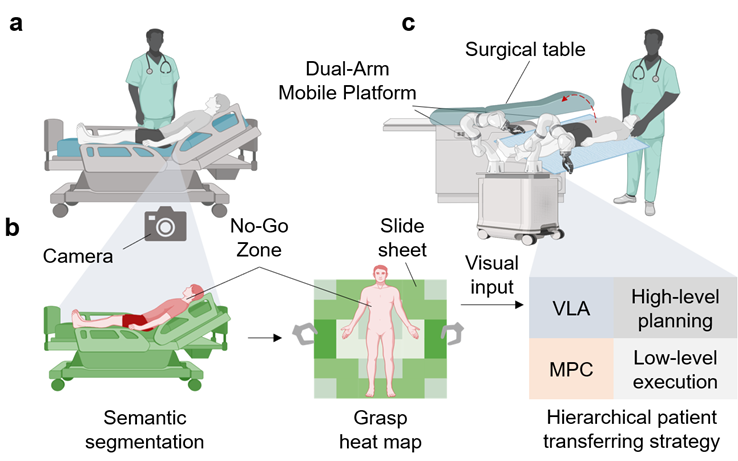
Patient transfer is a common but high-risk task in hospitals. It requires close physical contact, typically involves two to four nurses, and is a leading cause of occupational musculoskeletal injuries. Fully autonomous robots cannot yet guarantee safety or ethical reliability in such complex and dynamic clinical interactions, and existing patient-lifting robots, though mechanically capable, have seen limited clinical adoption. Training a human-aware policy through conventional imitation learning faces a structural data bottleneck: real nurse demonstrations are costly to collect, restricted by patient-privacy regulations, and unable to capture the rare, safety-critical events that matter most. To address this, we propose learning a human-behavior world model, anchored on a small dataset of real expert demonstrations, that generates realistic human behaviors in human–robot patient-transfer scenarios. This generated interaction data is then used to train a vision–language–action (VLA) policy, substantially reducing the amount of real demonstration data required. The trained policy is deployed through predictive shared control, enabling safe and efficient patient transfer with only a single nurse. In mannequin trials, we target a single-nurse transfer success rate of at least 85% and a reduction in peak nurse exertion of at least 50%.
Biosensors
At the AIME Lab, we are tackling one of the most persistent challenges in bioelectronics—the mechanical mismatch between rigid devices and the body’s soft, dynamic tissues. To overcome this barrier, we have developed a reconfigurable liquid cardiac sensor that conforms seamlessly to biological motion, enabling ambulatory heart monitoring without interference from movement or other physiological activities.
Using ultrahigh-resolution 3D skin imaging, we precisely map the complex surface of the wrist and model the sensor–tissue interface to optimize performance. This adaptive design allows the liquid sensor to maintain high-quality cardiac signals (23.1 dB) even in motion-rich environments, surpassing conventional electrocardiogram benchmarks in mobility scenarios.
By combining material adaptability, biomechanical modeling, and precision sensing, this work moves us closer to wearable systems that provide continuous, reliable health data—no matter where life takes the user.

Smart textile
At the AIME Lab, we are reimagining healthcare by turning everyday clothing into intelligent, wearable medical platforms. Led by Dr. Xun Zhao, our team develops smart and electronic textiles that seamlessly integrate sensors, diagnostics, and therapeutic functions into comfortable, durable fabrics. These systems enable continuous monitoring, real-time health insights, and on-demand treatments—all without leaving the wearer’s side.
Our research spans innovative fabrication methods, advanced material design, and system integration to create textiles that are as functional as they are wearable. We target applications in chronic disease management, elder care, pandemic readiness, and preventative health, while also addressing data security, regulatory requirements, and the pathway to commercialization.
By embedding healthcare into what people already wear, we aim to make personalized, round-the-clock care both effortless and accessible—bringing the clinic to the individual, anytime and anywhere.

We have more ongoing projects!
You are welcome to reach out!