Population Health & Behavioral Modeling
About:
We develop models to understand how human behavior, social dynamics, and uncertainty influence health outcomes at the population level. Our research integrates machine learning, longitudinal data analysis, and behavioral modeling to study disease progression. We are particularly interested in how interventions and policies can improve long-term population health outcomes.
Projects
Chronic diseases develop over years, but healthcare data provide only incomplete snapshots of that progression. Clinical measurements may be collected irregularly, important transitions may occur between visits, and patients with the same diagnosis may follow very different health trajectories.
We develop probabilistic and data-driven models that reconstruct disease progression from sparse longitudinal data, identify distinct patient trajectories, and quantify uncertainty about future health states. Our methods combine expectation-maximization algorithms, Markov models, and statistical learning to transform fragmented patient histories into interpretable models of how disease evolves over time. As an example, we use EM-algorithms to fit sparse data-sets:
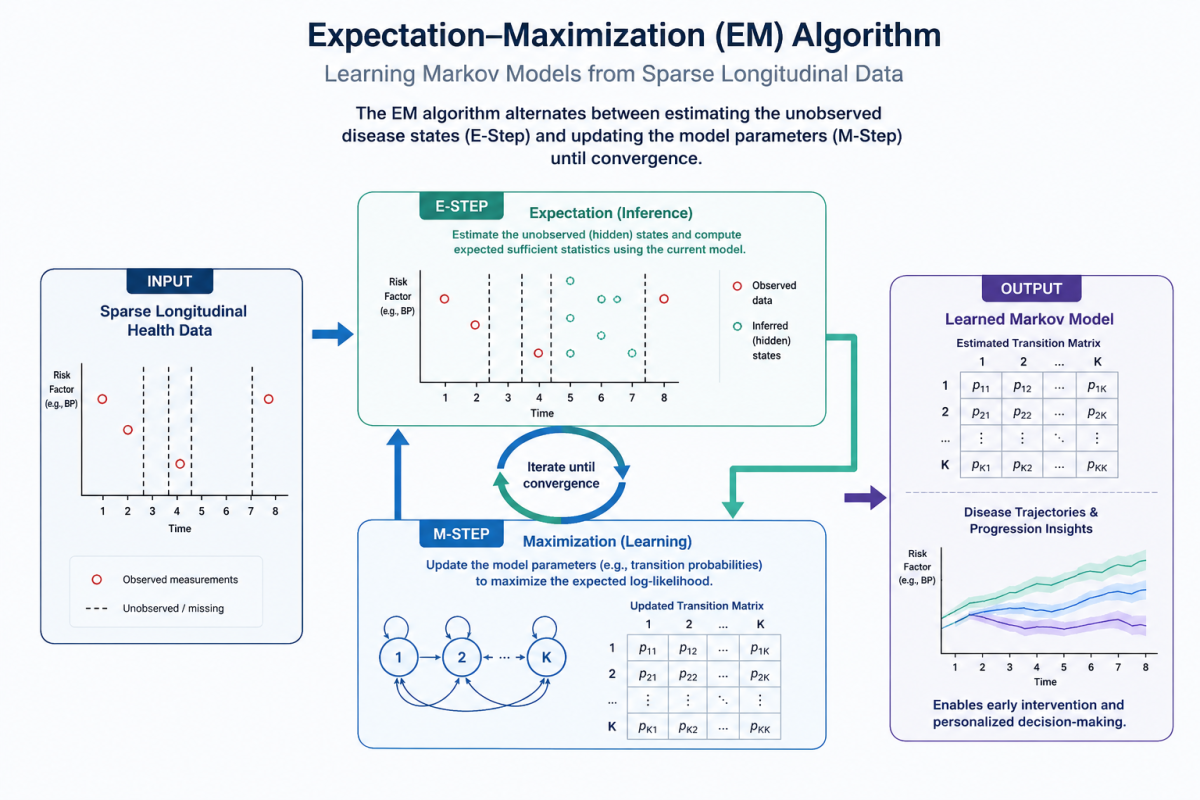
Current applications include cholesterol, blood pressure, and chronic kidney disease. Ultimately, this research aims to help clinicians identify patients at greatest risk of progression, determine when additional monitoring is valuable, and support earlier, more personalized preventive interventions.
We use machine learning, longitudinal data analysis, and statistical modeling to study the factors associated with adolescent substance use initiation and progression. Using large-scale population datasets, our research investigates how demographic, behavioral, family, and peer-related factors influence the use of alcohol, nicotine, cannabis, and polysubstance use over time. The goal of this work is to better understand behavioral risk dynamics and inform prevention strategies, early interventions, and public health policies.
We develop stochastic and predictive models to understand how individuals respond and adhere to healthcare interventions over time. Our research combines trajectory modeling, machine learning, and dynamic prediction methods to identify behavioral patterns and continuously update risk estimates as new patient information becomes available. By modeling adherence as a dynamic and evolving process, we aim to support personalized interventions, improve treatment effectiveness, and better understand long-term behavioral responses in healthcare systems.