Soft Materials
Our soft materials research program addresses challenges in sustainability and health.
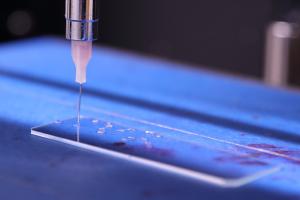
Soft materials can be easily deformed by external stresses, electric or magnetic fields or thermal fluctuations. Examples include liquids, polymers, foams, gels, colloids, granular materials, liquid crystals and most soft biological materials. We study the behavior of soft materials under small and large deformations, create active soft materials that can better interface with biological systems, and use advanced manufacturing technologies to transform soft materials to functional structures and devices.
Core Faculty

Liheng Cai
My lab’s research lies at the interface of soft (bio)materials and biology. We seek to understand and control the interactions between soft (bio)materials and living systems to solve challenges in sustainability and health. We do this using a combination of experimental and theoretical approaches.

David L. Green
Our group focuses on the synthesis of well-defined nanoparticles, their dispersion into polymer solutions and melts, and their suspension rheology. With our fundamental studies, we seek to optimize processing to achieve a desirable microstructure in industrial suspensions, and to set a foundation for developing constitutive rheological models.
Associated Labs and Groups

Soft Biomatter Lab Tour: Professor Cai and the graduate students in the Soft Biomatter Lab give an overview of their work and the exciting aspects of their research.
-

UVA Electrical Engineer Nikos Sidiropoulos Wins IEEE Fourier Award, Among Signal Processing’s Highest Honors
Read NowElectrical engineering professor Nikos Sidiropoulos was recognized for his work on multidimensional data — an area spanning streaming recommendations, cellphone connectivity and medical imaging.
-

Four UVA Engineering Faculty Earn NSF CAREER Awards
Read NowFour early-career faculty at the University of Virginia School of Engineering and Applied Science have earned prestigious National Science Foundation CAREER Awards.
-

Chen’s NSF CAREER Award Supports UVA Engineering Artificial Intelligence Research to Better Forecast Infectious Disease Epidemics
Read NowA UVA Engineering researcher is using AI to develop computational tools that improve infectious disease forecasting, guide public health decisions and strengthen disease surveillance.